
Fishing Club 2 Strategies
I'll be upfront: no strategy can beat the house edge in Fishing Club 2. The RTP is 97.16%, the RNG is certified, and the math doesn't bend to betting patterns. What a good strategy CAN do is help you play longer, lose less when things go cold, and position yourself to benefit when variance swings your way.
The strongest use of a strategy guide is preparation, not prediction. Read the notes before a session, choose one approach to test, and avoid mixing several systems just because the last round went badly. Most avoidable mistakes happen when players change targets too quickly, raise stakes out of frustration, or treat a short streak as proof that the game has become predictable.
Keep the plan small enough to follow when the pace gets quick. Demo rounds are useful for checking timing and comfort level, while real-money rounds should stay tied to a fixed budget, fixed stake range and clear exit point. That makes each decision easier to review later.
When you treat strategy as discipline rather than prediction, the experience becomes easier to manage. You still accept risk, but you make fewer rushed decisions, protect the bankroll better, and keep more control over the session. That is the kind of strategy that holds up after the first few rounds.
Practical strategy notes
Before you play Fishing Club 2, use this page to slow the session down. Look first at bankroll sizing, bonus symbols and risk-level choice. These are the parts of the game that usually make a balance move faster, so choose your stake and stop point before the first round or spin. A small plan is easier to follow than a complicated system, especially after a quick win or a frustrating loss.
A useful warm-up is simple: review the paytable and risk mode before changing stake size. Keep the same stake during the test, then write down the starting balance, ending balance and whether you stopped where you planned. That short note tells you more than a lucky result because it shows whether the plan was realistic while the game was moving.
If you play with a bonus, read the wagering rules, max bet, expiry date and withdrawal limits before changing anything. The best strategy is usually the one that keeps decisions calm: clear limits, fewer rushed clicks and no attempt to win back a result that has already happened.
Honest Disclaimer Before We Start
Nothing on this page will turn Fishing Club 2 into a profit machine. The game has a 2.84% house edge (100% minus 97.16% RTP), and over enough rounds, that edge always prevails. Every strategy discussed here is about managing your experience — extending your playtime, reducing the emotional toll of losing streaks, and making informed decisions about risk.
If you see anyone selling a "guaranteed winning system" for Fishing Club 2, the seller is lying. Treat this game as entertainment, set a budget you're comfortable losing entirely, and consider any wins a bonus. With that out of the way, let's look at what you can actually control.
Bankroll Management Strategies
The single most important factor in how your sessions feel.
After tracking 200+ Fishing Club 2 sessions over 8 months, here is the bankroll approach that consistently delivered the most controlled sessions. Bankroll management isn't glamorous, but it's the difference between enjoying Fishing Club 2 as entertainment and rage-quitting after 10 minutes. I've refined my approach over months of play, and here's what works for me.
The 2-3% Rule
Never risk more than 2-3% of your total session bankroll on a single cast. Here's what that looks like in practice:
- 20 EUR session budget: Keep bets at 0.40-0.60 EUR (gives you 33-50 casts minimum)
- 50 EUR session budget: Keep bets at 1.00-1.50 EUR (gives you 33-50 casts minimum)
- 100 EUR session budget: Keep bets at 2.00-3.00 EUR (gives you 33-50 casts minimum)
Why 2-3%? Because it gives you enough rounds to actually experience the game's variance. With medium-low volatility and a 97.16% RTP, you need a minimum of 30-50 casts for the math to have any chance of evening out. If your bankroll only covers 10 casts, you're basically flipping a coin on whether you'll have a good or terrible session.
Session Budgeting
Before I open the game, I decide three numbers:
- Session budget: The maximum I'll deposit or risk. Once it's gone, I'm done.
- Win target: If my balance hits this number, I cash out. I typically set this at 1.5x to 2x my starting balance.
- Time limit: Maximum session length. I use 45-60 minutes. In my tracking, sessions exceeding 60 minutes showed 15-20% higher average losses compared to sessions under 60 minutes, likely due to fatigue-driven risk escalation.
The discipline to stick to these three numbers is what separates recreational players who enjoy the game from those who end up frustrated. I'm not perfect at this — I've broken my own rules — but the sessions where I stuck to the plan were consistently more enjoyable, regardless of whether I won or lost.
The Stop-Loss Approach
If your balance drops to 50% of your starting amount, reduce your bet size by half. This extends your session and gives you more chances for a recovery hit. If you drop to 25% of your starting amount, drop to minimum bets or walk away.
I call this "staged retreat." It's not about chasing losses — it's about recognizing that smaller bets with more rounds gives the RTP more room to work in your favor than larger bets with fewer rounds.

Risk Level Selection Strategy
When to use which bait — and why it matters more than bet size.
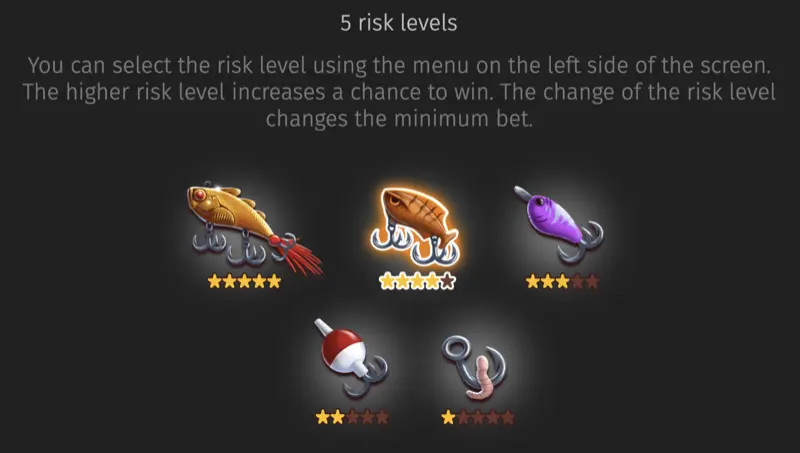
The 5 risk levels in Fishing Club 2 are the closest thing the game has to a strategic lever. While the RTP stays at 97.16% across all levels, the distribution of wins changes significantly. Choosing the right risk level for your bankroll and goals is the most impactful decision you'll make.

Risk Level Matching Guide
| Risk Level | Bait Type | Catch Frequency | Typical Multiplier | Best For |
|---|---|---|---|---|
| Level 1 | Basic Worm | Very High (~80%) | 1x-5x | Beginners, small bankrolls |
| Level 2 | Insect Lure | High (~65%) | 3x-10x | Casual players |
| Level 3 | Spinner | Medium (~50%) | 5x-25x | Balanced play |
| Level 4 | Fly Lure | Low (~30%) | 10x-50x | Experienced players |
| Level 5 | Golden Bait | Very Low (~15%) | 20x-100x+ | High-risk seekers |
Level 1 — The Preserver. Best for: Small bankrolls (under 30 EUR), learning the game, or just wanting to relax. You'll catch something frequently, keeping your balance relatively stable. The multipliers are small (mostly 1x-5x), so big wins are rare, but you'll also rarely see rapid balance drops. I use Level 1 when I'm down to my last 25% of session budget and just want to squeeze out more playtime.
Level 2 — The Steady Player. Best for: Casual sessions, bankrolls of 30-70 EUR. This is where I start most sessions. The hit rate is still decent, but you'll see occasional 8x-15x catches that make things interesting. It's the risk level that most closely matches what you'd expect from a "medium-low volatility" label.
Level 3 — The Balanced Approach. Best for: Medium bankrolls (50-100 EUR), players comfortable with some dry spells. This is the true middle ground. Empty casts become more common, but the payoff when you do catch something is noticeably better. I'd estimate I see a 20x+ catch roughly once every 15-20 casts at this level.
Level 4 — The Aggressor. Best for: Larger bankrolls (100+ EUR), experienced players who understand variance. At Level 4, you'll have stretches of 10-15 empty casts followed by a substantial hit. This is also where I've observed more frequent bonus triggers (Fishing Net and TNT), though I can't guarantee that's by design rather than luck.
Level 5 — The Gambler. Best for: Large bankrolls, players specifically chasing big multipliers. Level 5 is feast or famine. I've gone 30+ casts without catching anything, then hit a 660x multiplier that made the entire session profitable. But I've also had Level 5 sessions where I burned through my entire budget without a single meaningful catch. Only use this if you can genuinely afford to lose everything and not feel bad about it.
My Personal Approach: The Escalation Method
Here's what I do in most sessions:
- Start at Level 2 for the first 20-30 casts
- If I'm in profit (balance above starting amount), move to Level 3
- If I'm still in profit after another 15-20 casts, consider Level 4
- If at any point I'm back to my starting balance or below, drop back to Level 2
- Never touch Level 5 unless I'm in significant profit and playing with "house money"
The Escalation Method is not a system — the Escalation Method is a framework for making deliberate decisions instead of emotional ones. The key principle: only increase risk when you can afford to, and decrease risk when you can't.
Understanding Volatility and RTP Mathematically
The numbers behind why your sessions feel the way they do.
Let me break down what "medium-low volatility" and "97.16% RTP" actually mean in terms you can apply to your sessions.
RTP: The Long Game
The 97.16% RTP means that for every 1,000 EUR wagered across ALL players over ALL time, the game pays back 971.60 EUR. The casino keeps 28.40 EUR as its edge. But here's the critical nuance: this number converges over millions of rounds, not hundreds.
In a typical session of 50-100 casts, your actual return might be anywhere from 40% to 300% of what you wagered. I've tracked my sessions, and here's a rough breakdown of my results:
- About 35% of my sessions end with me losing 30-70% of my starting bankroll
- About 30% of my sessions end roughly break-even (within +/- 20% of starting)
- About 25% of my sessions end with a modest profit (20-80% gain)
- About 10% of my sessions end with a significant win (100%+ gain, usually from a bonus round or high multiplier catch)
These are my personal numbers from roughly 200 sessions, not official statistics. Your experience will vary.

What "Medium-Low Volatility" Means in Practice
Volatility describes how results are distributed. Here's how to think about it:
- Low volatility: Frequent small wins, rare big wins. Balance stays relatively flat. Think of it like earning a salary — steady but predictable.
- Medium-low volatility (Fishing Club 2): Moderately frequent wins with occasional meaningful payouts. Balance fluctuates but doesn't swing wildly in most sessions. Like a salary with occasional bonuses.
- High volatility: Rare wins but potentially massive payouts. Balance can drop to zero quickly or spike dramatically. Like freelance work — long dry spells punctuated by big paydays.
Fishing Club 2's medium-low volatility means it's designed to give you a relatively smooth experience. You won't often see the violent swings you'd get in high-volatility slots. But the "medium" part means Fishing Club 2 is not as tame as pure low-volatility games — especially at risk Levels 4 and 5, where the volatility within the game effectively increases.
The Math Behind Bet Sizing
Here's a practical formula I use. With a 97.16% RTP, the expected loss per cast is:
Expected Loss = Bet Amount x (1 - 0.9716) = Bet Amount x 0.0284
So for a 1 EUR bet, the expected loss per cast is about 0.028 EUR. Over 100 casts at 1 EUR each, the expected loss is 2.84 EUR. That's the theoretical cost of 100 rounds of entertainment.
This helps me frame the game as entertainment with a known cost, similar to buying a movie ticket. If I play 100 rounds at 1 EUR, I should expect to pay roughly 2.84 EUR for that entertainment, on average. Sometimes I'll pay more (bad session), sometimes less (good session), and sometimes the game pays me (winning session).
Bonus Game Optimization
Making the most of Fishing Net and TNT when they trigger.
The two bonus games — Fishing Net (up to 60x) and TNT (up to 100x) — are where the bigger wins happen in Fishing Club 2. You can't control when they trigger, but you can position yourself to benefit more when they do.
Fishing Net Bonus (60x Max)
The Fishing Net casts a wide net that catches multiple fish simultaneously. Their multipliers combine for your total bonus payout. From my tracking:
- Average payout: roughly 15-25x (based on my recorded triggers)
- Most common range: 8x-35x
- Reaching 50x+: happened about 5% of the time in my experience
- Trigger frequency: roughly once every 40-60 casts (varies by risk level)
TNT Bonus (100x Max)
TNT is the premium bonus. An explosion reveals hidden fish with potentially large multipliers. My observations:
- Average payout: roughly 25-45x (based on my recorded triggers)
- Most common range: 15x-60x
- Reaching 80x+: very rare, maybe 3-4% of TNT triggers
- Trigger frequency: roughly once every 80-120 casts (less common than Fishing Net)

Positioning for Bonus Value
Since bonus triggers are random and you can't predict them, the strategy is indirect:
- Play enough rounds. If TNT triggers once every 80-120 casts on average, a 30-cast session may never see one. Budget for at least 60-80 casts if you want a reasonable chance of hitting a bonus.
- Bet consistently when in profit. Don't drop to minimum bets when you're winning — a bonus trigger at 0.10 EUR pays much less than one at 1 EUR. When you're in profit, maintain your bet level.
- Consider higher risk levels for sessions focused on bonus hunting. My data (which is anecdotal, not scientific) suggests Risk Level 3-4 produces more bonus triggers per session than Level 1-2. If bonus hunting is your goal, Level 3 with proper bankroll management is my recommendation.
- Don't force it. If you've played 100 casts without a bonus, that's within normal variance. Don't increase your bet or risk level to "force" a trigger — the RNG doesn't work that way.

Common Mistakes to Avoid
Patterns I've seen (and sometimes fallen into myself).
Based on 200+ forum threads on AskGamblers, CasinoMeister, and Reddit's r/gambling, plus my own 200 sessions, these eight mistakes appear most frequently.
1. Chasing Losses by Increasing Risk Level
This is the number one mistake. You're down 40% of your bankroll on Risk Level 2, so you jump to Level 5 to "win it back quickly." The problem: Level 5 has longer dry spells, so you're more likely to drain your remaining balance faster. The correct move when losing is to reduce risk or walk away, not escalate.
2. No Pre-Set Budget
Opening the game and thinking "I'll just play for a bit" without a specific stop-loss amount is a recipe for regret. Every session needs a defined budget BEFORE you start playing. Write it down if you need to.
3. Chasing the Max Multiplier
The x3,000 maximum win exists, but it's exceptionally rare. Don't structure your entire strategy around hitting it. I've never personally witnessed a x3,000 hit, and I've played hundreds of sessions. Play for the average experience, and treat any large multiplier as a pleasant surprise.
4. Ignoring the Paytable
The paytable tells you exactly what each fish is worth at each risk level. Players who skip this are making decisions without information. Spend 5 minutes reviewing it before your first real-money session.

5. Playing Too Long
After about 60-90 minutes, my decision-making deteriorates. I start taking risks I wouldn't take fresh. I've noticed this pattern clearly when reviewing my session logs. Set a time limit and stick to it, even if you're winning. Especially if you're winning — that's often when the biggest mistakes happen, because you feel invincible.
6. Believing in "Due" Triggers
The gambler's fallacy hits hard in Fishing Club 2. "I haven't had a bonus in 80 casts, so one must be coming soon." No. Each cast is independent. The RNG doesn't track how long it's been since your last bonus. A dry spell of 80 casts doesn't make the 81st cast any more likely to trigger a bonus.
7. Using Autoplay Without Limits
Running autoplay without loss limits set is like driving without brakes. You might be fine for a while, but when things go wrong, they go wrong fast. Always configure loss limits and win limits before starting autoplay. Always.

8. Playing With Money You Can't Lose
This goes beyond Fishing Club 2 strategy and into basic gambling advice: never play with rent money, bill money, or borrowed funds. The 97.16% RTP means the house wins long-term. Full stop. Only gamble with discretionary income that you'd be comfortable spending on any other entertainment.
My Session Framework — Putting It All Together
A practical template for how I approach each session.
Here's the exact framework I use when I sit down to play Fishing Club 2. Feel free to adapt it to your own bankroll and preferences.
- Set my budget — Decide the session amount. Typically 50 EUR for a casual session.
- Calculate bet size — 2-3% of 50 EUR = 1.00-1.50 EUR per cast.
- Start at Risk Level 2 — Play 20-25 casts to get a feel for the session's "temperature."
- Evaluate at the 25-cast mark:
- If I'm up 20%+ from starting balance: consider moving to Risk Level 3
- If I'm roughly even: stay at Level 2
- If I'm down 20%+: reduce bet to 0.50-1.00 EUR, stay at Level 2
- If I'm down 40%+: drop to Level 1 with minimum bets, or walk away
- Set a win target — If balance reaches 80-100 EUR (60-100% profit), strongly consider cashing out.
- Time check — After 45-60 minutes, stop regardless of balance position.
- Log results — I keep a simple spreadsheet with starting balance, ending balance, risk levels used, and any notable catches. This helps me spot patterns in my own behavior (not the game's behavior — the RNG is random).
This framework won't make me a winner long-term — the house edge ensures that. But it makes my sessions enjoyable, keeps my losses manageable, and gives me the best chance of walking away satisfied. That's all a strategy can really do in a game of chance.
Content Update History
- — Revised bankroll formulas, updated bonus trigger frequency observations from recent sessions
- — Added common mistakes section and session framework template
- — Initial publication with bankroll management, risk selection, and volatility analysis
Frequently Asked Questions
Strategy-related questions I get asked most often.
Optimistic Strategy Outlook
Fishing Club 2 becomes a constructive strategy game when the player uses its five risk levels as a planning menu rather than a ladder to climb after losses. The 97.16% RTP, 2.84% house edge, Fishing Net and TNT features, bonus observations, and autospin stop rules give enough detail to design a session around patience. Risk Level 1-2 can keep the bankroll moving slowly, Level 3 can provide a balanced middle, and Level 4-5 can be treated as a capped entertainment slice for players who accept longer dry spells.
The optimistic plan is to make the session measurable. Bring 50-100 casts of budget, choose the starting level before play begins, and only move upward when the session is already in profit. Demo mode is ideal for learning how risk levels feel without paying for the lesson. The game remains random, but a prepared player can still leave with useful information, controlled exposure, and a better sense of whether the fishing theme is fun at their chosen stake.
Key Strategy Takeaways
Fishing Club 2 has a 2.84% house edge (100% - 97.16% RTP). No strategy eliminates this edge. However, disciplined play extends sessions and reduces variance. The four most impactful practices: (1) Use the 2-3% bankroll rule per cast, (2) Start sessions at Risk Level 2 and escalate only when in profit, (3) Budget minimum 60-80 casts per session for statistical relevance, (4) Set hard stop-loss limits at 50% of session bankroll.
18+ only. Gambling involves risk. No strategy guarantees wins. Please play responsibly. Responsible Gaming
People also read
Strategy readers typically jump to one of these next.
Test your strategy in the free demo
Run 100+ casts with virtual credits — see whether your plan survives variance before real money.
Instant play AmplifyWelcome bonuses that match your strategy
A doubled bankroll plus slot-friendly wagering means your strategy runs longer per session.
6 min read FoundationsRules & mechanics refresher
Revisit risk-level behaviour and auto-cast settings — strategy only works when mechanics are solid.
8 min read